Mastering Visual Data: The Power of Business Report Icons in Modern Design
In an era where information moves at the speed of light, the ability to communicate complex data quickly and effectively is a superpower. Whether you are a small business owner presenting quarterly earnings, a wedding planner organizing seating charts, or a creative entrepreneur designing merchandise, the visual representation of data plays a pivotal role. At the heart of this visual communication lies the business report icon. Specifically, designs featuring charts, pie graphs, and bar metrics have become essential tools for conveying analytics concepts in a flat, modern aesthetic. This article explores the significance of these digital assets, how they bridge the gap between raw numbers and human understanding, and why downloading high-quality, printable versions can transform your creative and professional projects.
The Language of Flat Design and Statistical Icons
To understand the value of a flat design statistical report icon, we must first look at the evolution of graphic design. In the past, digital icons were often skeuomorphic, meaning they tried to mimic real-world textures like leather, glass, or paper. While detailed, these designs often cluttered screens and distracted from the core message. Enter flat design. This style strips away unnecessary gradients and shadows, focusing on clean lines, bold colors, and simple geometry.
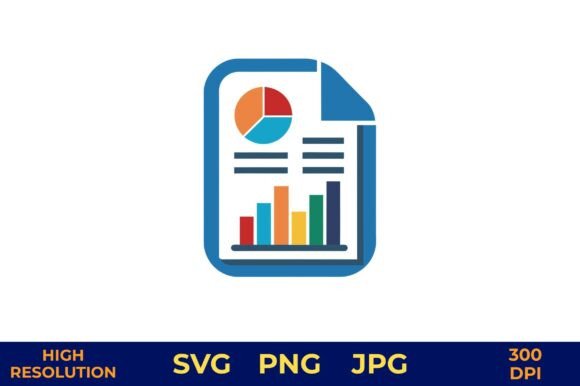
When applied to business analytics, flat design creates a universal language. A pie chart rendered in flat style immediately signals "proportion" or "market share" without needing words. A bar graph instantly communicates "growth" or "comparison." These icons are not just decorative; they are functional semiotics. They allow viewers to process statistical information in milliseconds. For beginners in design or business, utilizing pre-made, high-quality icons ensures that your data visualization looks professional and adheres to modern aesthetic standards without requiring advanced illustration skills.
Why High-Resolution Digital Assets Matter
You might wonder why the specifications of a digital download matter so much. When you acquire a digital product, such as a 1 High Quality SVG, PNG, or JPG file, the technical details determine its versatility. The offer of files sized at 4200px X 4200px with a resolution of 300 dpi is crucial for several reasons.
First, 300 dpi (dots per inch) is the industry standard for print. If you intend to use these icons on physical products like mugs, t-shirts, posters, or wedding invitations, low-resolution images will appear pixelated and blurry when printed. A 300 dpi file ensures crisp edges and vibrant colors, maintaining the integrity of the flat design. Second, the dimensions of 4200x4200 pixels provide massive scalability. You can shrink the image for a social media post or enlarge it for a large-format banner without losing quality.
Furthermore, the inclusion of transparent backgrounds is a game-changer for designers. A PNG with transparency allows you to place the business report icon over any colored background, texture, or photograph without an unsightly white box surrounding it. This flexibility is essential for branding, where consistency across different mediums is key.
Bridging the Gap: From Corporate Analytics to Creative Projects
Traditionally, business report icons were confined to corporate PowerPoint presentations and annual financial reports. However, the modern application of these symbols has expanded far beyond the boardroom. The concept of business analytics has permeated daily life, education, and personal organization. People now track their fitness goals, manage household budgets, and plan elaborate events using data-driven approaches. Consequently, the imagery associated with these tasks has become relevant to a much broader audience.
Consider the wedding industry. Modern couples often treat their wedding planning like a project management task. They have budgets, guest lists, and timelines. A flat design pie chart icon can be used creatively on wedding menus to show the breakdown of courses, on seating charts to visualize table arrangements, or on Save the Date cards to playfully indicate the percentage of guests confirmed. By using a professional business icon in a celebratory context, you add a touch of modern sophistication and wit to the stationery.
Similarly, in the realm of social media design, content creators constantly need to illustrate growth, statistics, or tips. An influencer sharing "5 Tips for Saving Money" can use a bar graph icon to visually break down expenses. A photographer branding their portfolio might use these icons to create infographics about their booking rates or client satisfaction scores. The versatility of a single high-quality icon allows it to serve multiple purposes across different platforms.
Practical Applications for Entrepreneurs and Creatives
For those running a small business or a side hustle, the ability to just download and print your own assets is both cost-effective and efficient. Instead of hiring a graphic designer for every small task, having a library of versatile icons empowers you to maintain brand consistency. Here is how these assets fit into various practical scenarios:
- Branding and Identity: Use the icons on business cards, tags, and stickers to reinforce a data-driven or analytical brand personality.
- Merchandise Creation: With 300 dpi files, you can easily print these designs onto mugs, pillows, and t-shirts. Imagine a "Data Nerd" t-shirt featuring a stylish flat design chart, appealing to analysts and students alike.
- Educational Materials: Teachers and educators can incorporate these icons into worksheets, planners, and presentation slides to make learning about mathematics and economics more engaging for students.
- Event Planning: Beyond weddings, these icons work perfectly for corporate retreats, bridal shower decor, and conference materials where scheduling and statistics are discussed.
- Scrapbooking and Albums: For the crafty individual, these printable kits add a structured, modern element to memory keeping, perhaps documenting a year of family savings or travel statistics.
Clarifying Common Misunderstandings About Digital Products
It is important to address a common assumption regarding digital downloads. When you purchase a file described as a digital product, it means no physical product will be delivered. There is no shipping wait time, no packaging waste, and immediate access to your files. However, this also means the responsibility of printing lies with the user.
Some users may assume that a digital file will automatically look good on any surface. This is not always the case if the wrong file format is chosen. For web use, a JPG or PNG is ideal due to smaller file sizes and compatibility. For professional printing or further editing, the SVG (Scalable Vector Graphics) format is superior. SVGs are math-based rather than pixel-based, meaning they can be resized infinitely without any loss of quality. Understanding the difference between these formats ensures you get the best results for your specific project.
Another misconception is that "flat design" implies "simple" or "cheap." On the contrary, creating effective flat design requires a deep understanding of composition and color theory. A well-designed statistical icon balances negative space and color contrast to ensure readability at any size. The high resolution (4200px) mentioned in premium downloads guarantees that the simplicity of the design does not come at the cost of detail.
The Role of Analytics in Everyday Creativity
We live in a world driven by data. From the algorithms that suggest our next favorite song to the metrics that determine the success of a marketing campaign, analytics are everywhere. Incorporating business analytics concepts into creative design helps demystify these numbers. It makes data approachable, friendly, and visually appealing.
When a florist uses a chart icon on their pricing list, it suggests transparency and organization. When a planner includes a graph in a productivity journal, it encourages the user to track their progress visually. These icons serve as a bridge between the cold hard facts of statistics and the warm, human element of creativity. They remind us that behind every number is a story, and behind every story is a design opportunity.
Conclusion: Empowering Your Projects with Professional Assets
The business report icon with charts and flat design is more than just a clipart image; it is a versatile tool for communication in the 21st century. Whether you are designing a corporate annual report, crafting a unique wedding invitation, or launching a line of printed merchandise, the quality of your visual assets matters. By choosing high-resolution, transparent, and scalable files, you ensure that your work stands out with professionalism and clarity.
Remember, the goal of using these icons is to enhance understanding. They simplify the complex, organize the chaotic, and add a layer of modern elegance to any project. As you explore the possibilities of printable kits, social media graphics, and branding materials, keep in mind that the right icon can speak louder than a thousand words. So, take advantage of the convenience of digital downloads, embrace the power of flat design, and let your creativity visualize the data that drives your world.
By integrating these elements thoughtfully, you not only improve the aesthetic appeal of your work but also foster a deeper connection with your audience. Whether they are clients, guests, or customers, clear visual communication builds trust and engagement. Start exploring the potential of statistical report icons today and transform the way you present information.